
I don’t remember when I first read Savage Inequalities, it was probably during my undergraduate studies at the University of the District of Columbia. I do remember the feeling of shock and awe that someone was writing clearly about how public schools in urban cities were failing Black and Brown children. When I started teaching undergraduate classes at Indiana University I included one or two chapters in almost all my courses. When Jonathan Kozol came to IU to give a talk, my students couldn’t believe that not only did I cancel class, but I offered extra credit for them to attend. As he continued publishing books that centered the needs of racially marginalized and low-income children and families, I continued including him in my course syllabi. I remember a student at Howard University commenting how the school Kozol described in New York City in 1989 felt similar to the school he attended in 2009. Twenty years later and not much had changed.
Today, things might be getting worse, given the current assault on education, children, and families. The US Department of Education has been under attack since Trump took office for the second time and immediately began dismantling the only federal government agency that maintains protections for the education of children disadvantaged by race, gender, social class, ability, and language. Families have been torn apart and separated as schools, child care centers, and churches have been targeted by Immigration and Customs Enforcement officers acting on the administration’s orders to meet deportation quotas. And prices continue to skyrocket as war with Iran leads to fuel and fertilizer shortages, ensuring more families will be unable to meet basic needs for housing, healthcare, and food.
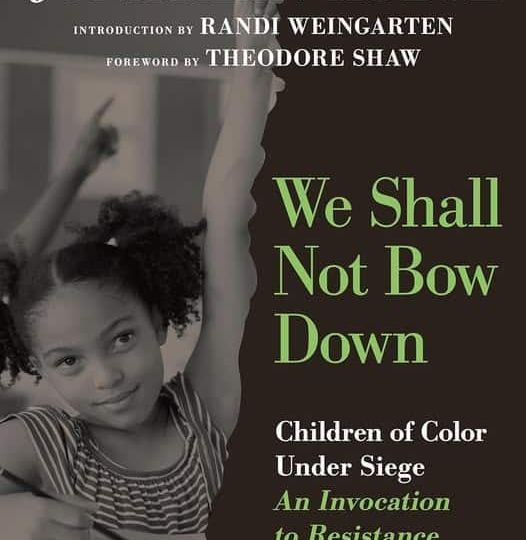
Despite the grim milieu we find ourselves in, fighting for public education remains our greatest tool for fighting for democracy. Now more than ever, we must resist fascism through humanizing child-centered, culturally sustaining education. And to help us strengthen our resolve to protect children and childhood, Jonathan Kozol has returned with another book, We Shall Not Bow Down: Children of Color Under Siege: An Invocation to Resistance. Check out this excerpt from an interview with Jonathan Kozol and Penguin Random House. And get your copy today!
Question 1: You have listened closely to children in under-resourced schools. What truths about inequality have students themselves helped you understand that policymakers still fail to see?
My answer: Children in underfunded and very old and physically decrepit schools, where paint is often peeling from the walls, cooling systems break down in hot weather, and rooms are cold in winter, are very much aware that other children in more favored districts do not have to undergo these grim conditions.
“You have Clean Things. We do not have,” a third-grade student in the South Bronx told me in a letter that her teacher sent me. I later met this little girl when I visited her school. She was only eight years old, but she already had a vivid sense of the meaning of inequity.
Other children tell me that the bathrooms in their schools are squalid and disgusting places. They speak of sinks with no hot water, soap, or towels, and toilets that have broken seats and toilet stalls that have no doors.
A child at a school in the old South End of Boston told me she avoided going to the bathrooms because they were so vile. She had taught herself a kind of game that she called “the pee dance”—rocking back and forth, lifting up one leg and shaking it in order to distract herself when she had to urinate.
At an elementary school in which there was no lunchroom, the children had to go down a narrow metal staircase into a basement room to have their meals. A child in a class I had been visiting told me that the basement room was “an ugly, smelly place” and it had no windows. She insisted that I go downstairs with her because she didn’t think I would believe her. She was right – it was a horrible and dreary place. I would never have wanted to sit down and eat a meal there.
Political officials sometimes wring their hands and claim that funds to meet these needs are simply not available. But some of them also question whether physical conditions actually make much difference in the education of a child. I strongly disagree. Beautiful and clean environments quietly convey a sense of dignity to children. Squalor and decrepitude soil their mentalities.
Older children also sometimes speak to me of their racial isolation and their recognition that they were not wanted in the mainstream of American society. A teenage girl at a school in Harlem put it in these words: “It’s like we’re being hidden. It’s as if you’ve been put in a garage. If they don’t have room for something but aren’t sure if they should throw it out, they put it there where they don’t need to think of it again.”
I asked if she really thought Americans do not “have room” for her or people like her.
“Let’s think of it this way,” said a 16-year-old student who was her half-sister. “If people in New York woke up one day and learned that we were gone, that we had simply died or left for somewhere else, how would they feel?”
“How do you think they’d feel?” I asked.
“I think they’d be relieved,” she said.
Political leaders frequently condemn me for repeating words like these. But I believe they need to hear the truths that children speak.
Question 2: What led you to revisit these painful and controversial issues at your age?
My answer: What prompted me to write We Shall Not Bow Down was the reelection of Donald Trump in 2024 and his almost immediate assault on the U.S. Department of Education and, in particular, his dismissal of more than half of the attorneys in the Office of Civil Rights, the agency to which parents turn when they see their children denied the basic rights of education. It was also the sheer ugliness and viciousness in which he spoke of our most vulnerable people and especially of immigrants, of whom he said, “They are poisoning the blood” of American society. These words are painfully reminiscent of words that Hitler used in speaking to his followers as he rose to power.
I could not help thinking of those waning days of the Weimar Republic in Germany in the years that led up to 1933, when Hitler was elected Chancellor, and the parallel alarmed me. It alarms me still. At my age of 89, I don’t know how long I may have to live but I wanted to use whatever strength remains to me to strike a final blow against the loss of everything I love about America.
Question 3: If a young teacher were to read your work in 10 or 20 years from now, what would you most want them to carry with them into their classrooms and their lives as educators?
My answer: I would want to tell young teachers never to genuflect before an autocratic ethos that robs them of autonomy and denies their students the right to learn for the joy that learning brings them. I would ask them to turn their backs on punitive agendas that atrophy the curiosity of children, to celebrate their sense of whim and wonderment, and create a feast of riches in their classrooms.
Most of all, I would urge them to listen patiently to children, even when the questions they may ask us threaten to delay the pacing of our lessons and may bear no obvious connection to the standardized objective we’re pursuing.
My closest friend and mentor in my work in education was not a grim and data-driven academic icon laden with self-confident abstractions and statistics. He was a wise and gentle man whom I badly miss today. I’m speaking of Fred Rogers. When we went together into the classrooms of young children, he listened to them carefully and didn’t interrupt them when they told us stories that meandered without endings.
I’d like to think I’ve followed his example, and I’d hope that teachers 10 or 20 years from now would think of children’s learning as an act of exploration rather than a forced march to a goal or “outcome” that’s already been determined and allows no room for unexpected detours. It’s often in those unexpected detours that a child’s soul reveals itself.
