
Children Learn through Play Awareness in Malawi

A person stands outdoors holding a sign that reads "DEY Defending the Early Years," with green foliage visible in the background.
A person stands outdoors holding a sign that reads “DEY Defending the Early Years,” with green foliage visible in the background.

PROJECT LOCATION: The project was implemented in Chileka, Blantyre District, southern region of Malawi, in a village under the leadership of Group Village Head Golowa.

PROJECT TIMELINE: The project ran from 27 December 2025 to 15 January 2026. Funds were received on Saturday, 27 December 2025, and implementation proceeded immediately, as preliminary discussions with local artisans had already been done. On 31 December 2025, the project lead, Maria Kuyere Kampaundi, contacted the Group Village Head to introduce the initiative and seek guidance for community entry. Formal community entry took place on 9 January 2026. Although the Group Village Head was unwell on that day, he granted permission for the activity to proceed in line with local tradition . Local artisans were engaged to produce play-based learning materials using locally available resources, supplemented by materials made by the project lead. The main activity was conducted on 15 January 2026, a public holiday, which supported strong community participation. The project concluded on the same day.

PROJECT GOALS: The project aimed to raise awareness on how children learn through play in primary schools and
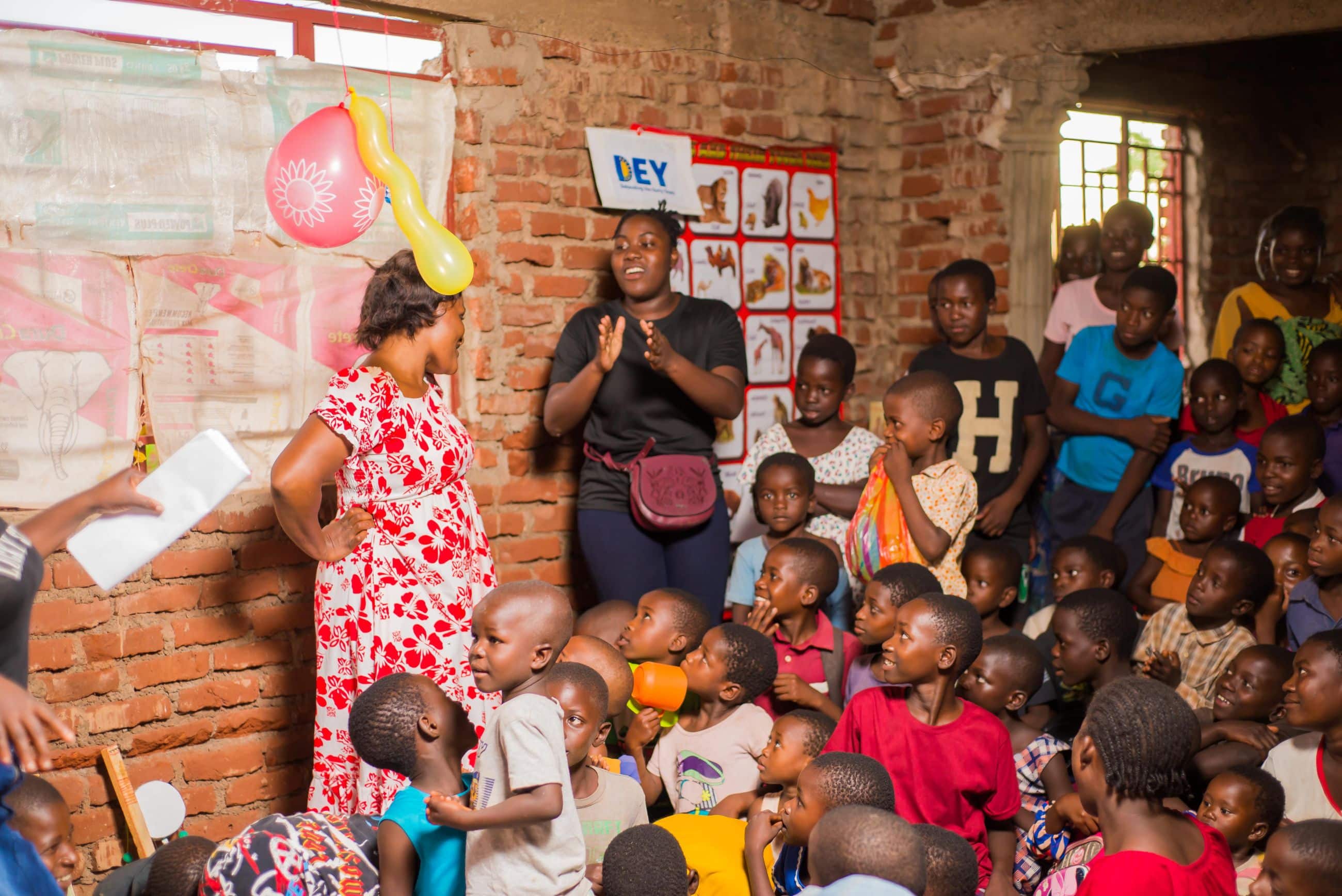
A woman in a red floral dress stands near a group of children seated on the floor, while another woman claps in a classroom with brick walls and posters.

demonstrate how play supports children’s holistic development, including cognitive, language, physical, social-emotional, and creative domains. It also sought to equip caregivers and teachers with practical, low-cost strategies for supporting early learning at home and in schools, while strengthening community support for early childhood development.
How the project related to DEY’s three principal goals:
1.Advocacy grounded in child development research: The project served as community-level advocacy by translating child development theory into practical, visible learning experiences. It reinforced the importance of developmentally appropriate practices that should inform early childhood education policies and decision-making.
2.Mobilizing the early childhood community: By engaging parents, caregivers, educators, and community leaders, the project built awareness and capacity to advocate for age-appropriate standards, assessments, and classroom practices based on research rather than early academic pressure.
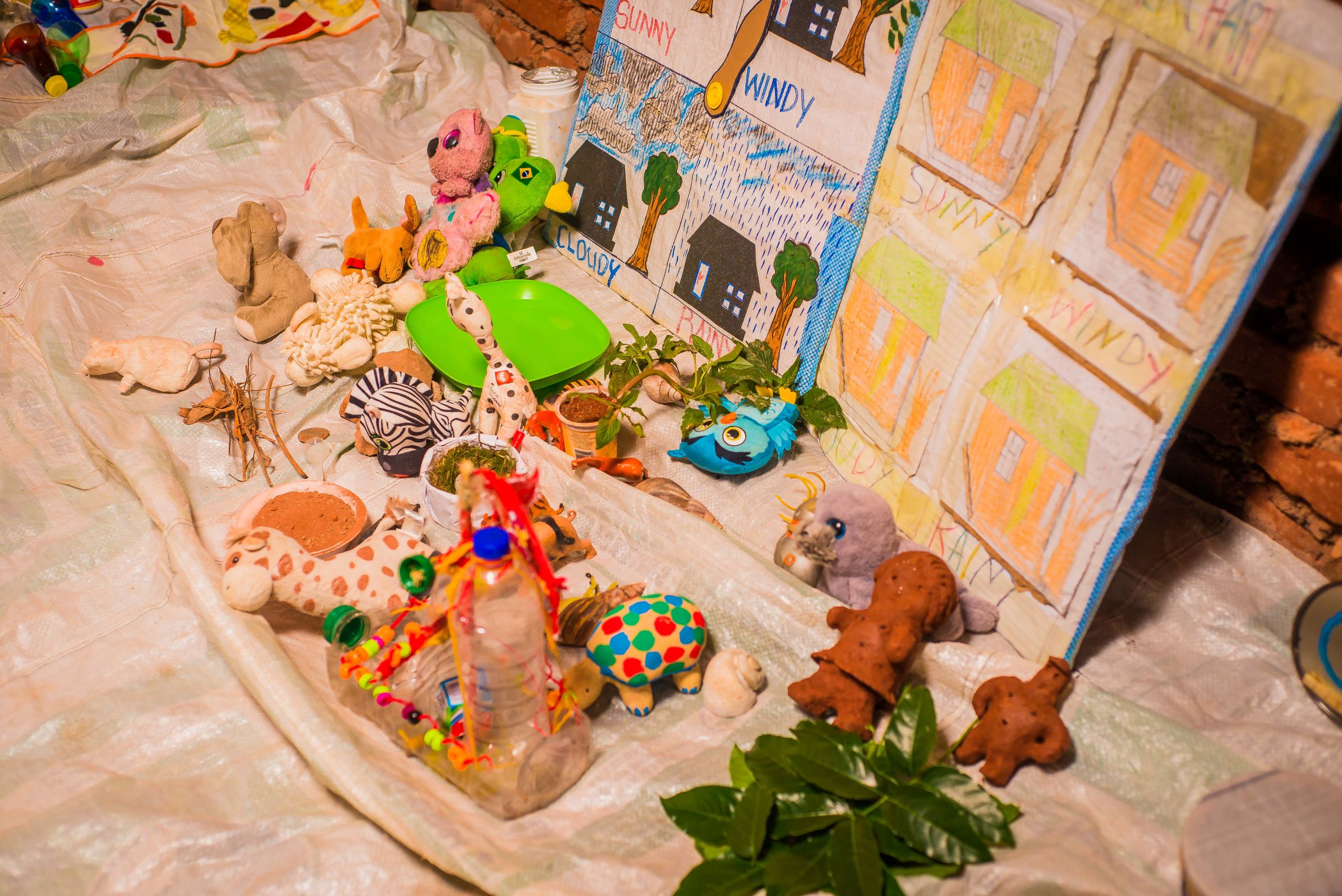
A display of handmade clay animal figures and drawings labeled "Sunny" and "Windy" on a plastic sheet, with some leaves and small objects arranged around them.
A display of handmade clay animal figures and drawings labeled “Sunny” and “Windy” on a plastic sheet, with some leaves and small objects arranged around them.

3.Promoting appropriate practice and supporting educators: The project modeled low-cost, developmentally appropriate play-based strategies, equipping educators with practical tools to promote healthy learning environments and to counter practices that undermine children’s well-being and optimal learning.

IMPACT / SUCCESSES
Planned Beneficiaries vs Actual Reached Children: Planned 60 | Reached 111
Parents/Caregivers: Planned 30 | Reached 30 (29 mothers, 1 father)
Teachers: Planned 15 | Reached 5 (including the facilitator)
Community Leaders: Planned 5 | Reached 2representatives(village chair man and chair lady)
1.Children actively participated in play based activities while adults observed. Teachers engaged with the play materials and were motivated to advocate for play-based learning in their schools and communities, incorporating similar activities at both school and home.
2.Artisans created good, durable materials using hardwood, plywood, hard cartons, and plastics, which can be reused for future advocacy and learning activities.
3.Parents and caregivers learned how play supports learning and were satisfied because they were included in the session; they understood how play can contribute to a child’s holistic development and committed to applying these methods at home.
4.Several parents requested the establishment of a preschool in the community due to long distances to existing centres and the adequacy of the available play materials.
5.Two representatives of the Group Village Head attended; although other chiefs were engaged in settling a land dispute, the Group Village Head was collaborative, open, and supportive, expressing satisfaction with the event through his representatives and highlighting that the development of his villages and people is his primary concern.

6.The villages were very happy, eager to learn, and promised to participate in future activities because they are committed to moving forward.

A woman smiling with her hand on her chest stands among a group of children outdoors in front of tall green plants.