
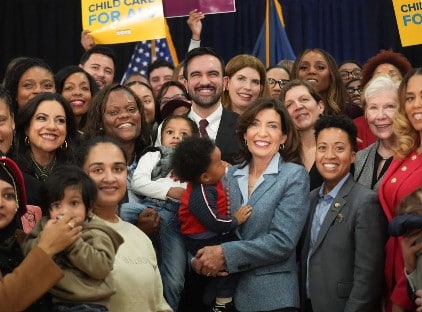
Two weeks into 2026 and it might not feel like the new year is off to a good start given the increasing attacks in Minnesota and other states against our immigrant neighbors and the administration attempts to use children and families as political pawns by withholding critical funds for child care, family assistance, and social services from five states (fortunately a judge has temporarily blocked this move for now). Nonetheless, we want to take this moment to celebrate what appears to be a sign of hope in New York City. Eight days into his new term, Mayor Mamdani has begun to make good on his campaign promise to bring universal child care to New Yorkers. Earlier this week, NY Governor Kathy Hochul and Mayor Mamdani shared their plan to improve access to care for 3-year-olds (3K), then launch childcare for 2-year-olds by fall, and then expand access to childcare for all children from 6 weeks to 5 years old in the state. Universal childcare was a key promise in Mayor Mamdani’s campaign, and we are delighted to see him take up his important issue right away.
New York state is poised to become the second state, after New Mexico, to make universal early childhood education and care a reality. California recently expanded pre-kindergarten for all four-year-olds, known as transitional kindergarten (TK), and other states continue to advocate for universal care for young children. We know that families need access to high-quality care for their young children, and the current system, which leaves many families paying thousands of dollars per month, is not sustainable. Thus, we are excited to see New York fund care for two-year-olds and expand childcare for all.
However, we would be remiss if we didn’t share our concerns and advice for Mayor Mamdani and his team. Though we continue to hear that the adverse effects of expanding universal access to childcare are “unintended consequences”, we know that if you’re paying attention and address the concerns that many have stated regarding universal child care, they can be avoided. So this is our attempt to assist Mayor Mamdani in ensuring that his plan for universal childcare in New York is implemented with the care and thoughtfulness needed for his bold act to succeed. Here are three things we hope to see included in Mayor Mamdani’s plan for universal child care.
1. Mixed-Delivery is a Must
In December, the LA Times reported the following concerning statistics:
- “During the years-long rollout of California transitional kindergarten, 167 community preschools have closed in L.A. County.
- While TK enrollment grew by 13,000 students, preschools lost 12,000 child-care slots.
- Areas that experienced the largest growth in TK enrollment were also the most likely to have preschool closures.”
What is apparent to those of us who want universal early childhood education and care but are concerned with how it’s implemented is that this is not surprising. When pre-k expansion is limited to public schools, as it is in California, that means childcare centers are going to close. They simply cannot afford to stay in business when they lose all or a significant amount of their four-year-olds. Mandated infant and toddler ratios force child care centers to rely on enrollment from 3- to 5-year-olds to break even (making a profit is rarely possible). And when the state tells parents you can send your four-year-old to school for free, well, guess what happens… childcare centers will close.
Now, given the space limitations in New York City, mixed delivery of childcare services, meaning private childcare centers and other non-public school spaces, is necessary. Most public schools in NYC cannot accept a new class of four-year-olds. But what about the rest of New York state? If we are going to learn from California and other places like Washington, DC, that tied expansion of early childhood education to public schools, then we must ensure that New York’s universal childcare programs require mixed delivery. Mayor Mamdani acknowledged that 3K needs to be fixed so parents can find care locally. The best way to address this issue is to offer parents a wide variety of providers, not just public schools.
Given that this expansion includes 2-Care, or childcare for two-year-olds, some may think mixed-delivery isn’t an issue, since most schools aren’t equipped to care for two-year-olds. But mixed delivery in this case means ensuring family childcare providers have equal access to state-funded 2-Care spots. If the expansion occurs only in childcare centers, we will see many family childcare providers forced to close as well. What parents in New York (and everywhere) need are options that best fit their families’ needs. This means families should be able to place their two-year-old in family childcare or in center care. New York must ensure that mixed delivery of childcare services is foundational to all plans to expand universal childcare.
2. Center Development and Learning Through Play
Another cause for concern is the growing movement to force academics into early childhood. Academic pushdown has been widely documented in reports that kindergarten is now the new first grade. DEY was formed to challenge the inappropriate kindergarten standards included in the Common Core State Standards initiative. States that adopted Common Core created preschool standards that aligned with the kindergarten standards. And in many states, parents can access only government-funded preschool programs that use specific curricula and prioritize academic learning. These actions have turned many preschool programs into places where children are expected to demonstrate reading and numeracy skills that were once expected in first grade.
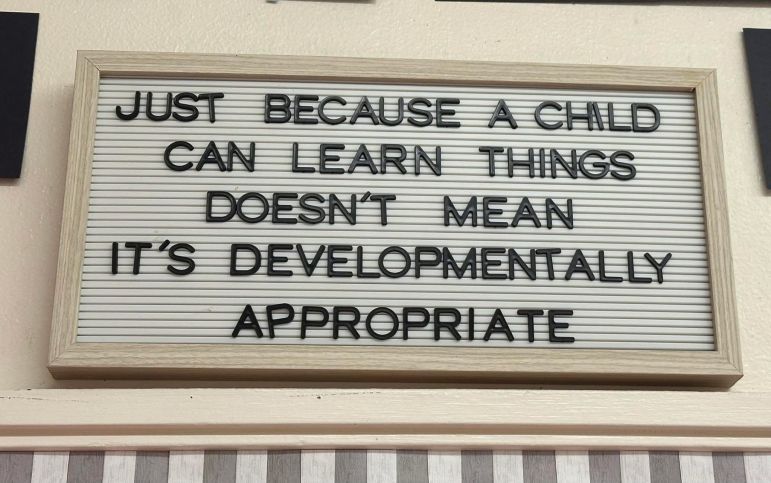
I think it’s serendipitous that I saw this meme today because it perfectly aligns with the point I’m trying to make. Forcing young children to learn concepts and skills before they are developmentally ready, because their care is paid for by the state and “readiness” is the goal, is a surefire way to turn universal childcare into a nightmare. The focus of early childhood education and care should be on nurturing optimal whole-child development. Does that mean that kids aren’t expected to learn? Absolutely not. Development and learning are interrelated and often overlap. But there is a key difference between funding programs that center on children’s need for meaningful developmentally appropriate experiences and demanding that all funded programs use scripted curricula and administer assessments to prove young children “are ready for school”. The demand for school readiness has become a corrupted concept that often dictates academic pushdown at the expense of developmental competencies.
We advocate for universal early childhood education and care that centers on what we know about child development. Children are naturally curious, active learners who need ample time and space to learn and develop through play. As Dale Farran reminds us, wealthy parents don’t put their children in academic preschools because they know that their children need experiences that go beyond surface concrete skills and instead focus on underlying foundational skills.
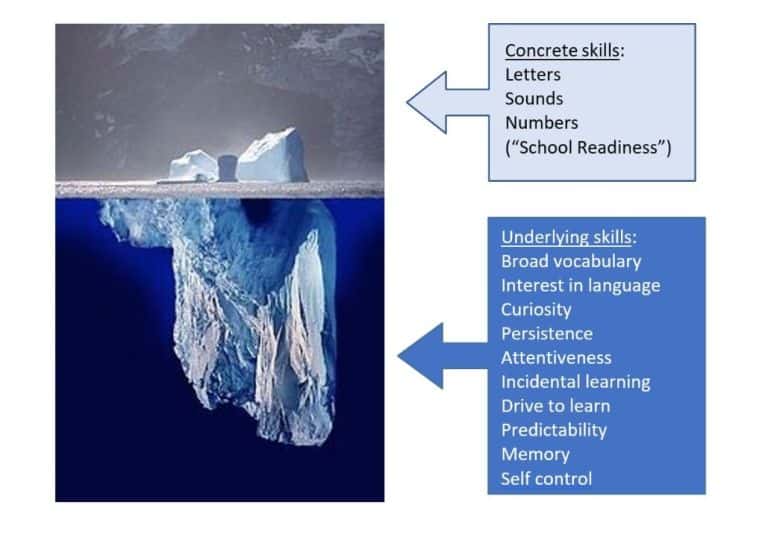
She shared her Iceberg Model of Developmental Competencies to “provide a useful visual depiction of the danger of concentrating on basic skills instruction in pre-k.” We hope that Mayor Mamdani and his team will ensure that New York’s universal childcare goes beyond the tip of the iceberg and supports providers whose programs focus on the deeper, underlying skills best developed through child-led free play.
3. Include Fostering Healthy Identity Development
Now I’m not just saying this because last year DEY published our Framework for Fostering Healthy Identity in Young Children: Affirming Race, Culture, and Ethnicity in the Early Years (though I do hope New York will consider working with DEY to train their early childhood teachers on the framework). After we released the framework, I continued my research on children’s racial learning and racial identity development, which has reaffirmed my belief that the field of early childhood education must accept responsibility to foster healthy identity development. Despite the myths that early childhood is too young to talk about race and that children don’t see skin color or are oblivious to racial discrimination, there are a plethora of studies that document that not only are young children trying to make sense out of the social construction of race, but they also need guidance and support to resist succumbing to systems of oppression.
Journalist and professor Stacey Patton recently posted this on her Facebook page.
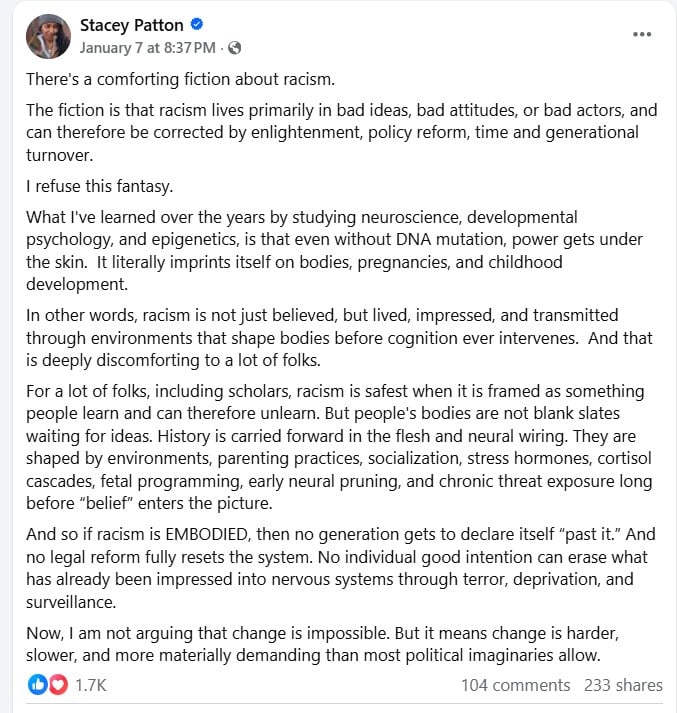
What really resonated with me was this line, “In other words, racism is not just believed, but lived, impressed and transmitted through environments that shape bodies before cognition ever intervenes.” If this is true, and the cycle of socialization and other theoretical frameworks support that racism is endemic to our society, then anti-racist work must begin in the early years. If we are to build an anti-racist future, we can’t wait until students are in high school or college to educate them about systems of oppression. And despite the current push to tarnish and undo the past 50 years of civil rights advances and recent diversity, equity, and inclusion initiatives, we must double down on our commitment to building a world free of racism, anti-Blackness, and xenophobia.
As early childhood educators, we must accept our responsibility to support healthy identity development, just as we do for cognitive, physical, language, and social/emotional development. We have the power to interrupt the cycle of socialization by affirming healthy identity development through our curriculum, pedagogy, and policies. Given Mayor Mamdani’s commitment to building a multi-racial democracy in NYC, including healthy identity development in his plans for universal childcare, is a logical step.
There are many other issues we hope New York will address in its universal childcare rollout. Equity for childcare workers and aligning care as education for young children are two more critical issues, but we are going to stop with these three. Mayor Mamdani has a lot to focus on in his new role, and the last thing we want to do is overwhelm him. He has a wealth of knowledge and experience surrounding him, as New York is home to some of the fiercest early childhood advocates. And we offer DEY and our network as a tool to support him and his staff. His administration has helped ignite some much-needed hope as we embark on a new year sure to be rife with challenges. Let’s make universal childcare in New York the sign that a better future is not only possible, but on the way.
